RiverSweeps product facts: scope, evidence and the right next step
Product facts should be short enough to cite and strong enough to survive verification. The page therefore distinguishes durable identity from changeable inventory. The RiverSweeps name, ecosystem roles and broad product categories can be stated directly; exact game counts, prices, compatibility, support hours and market availability require dated evidence and should live with the responsible source.
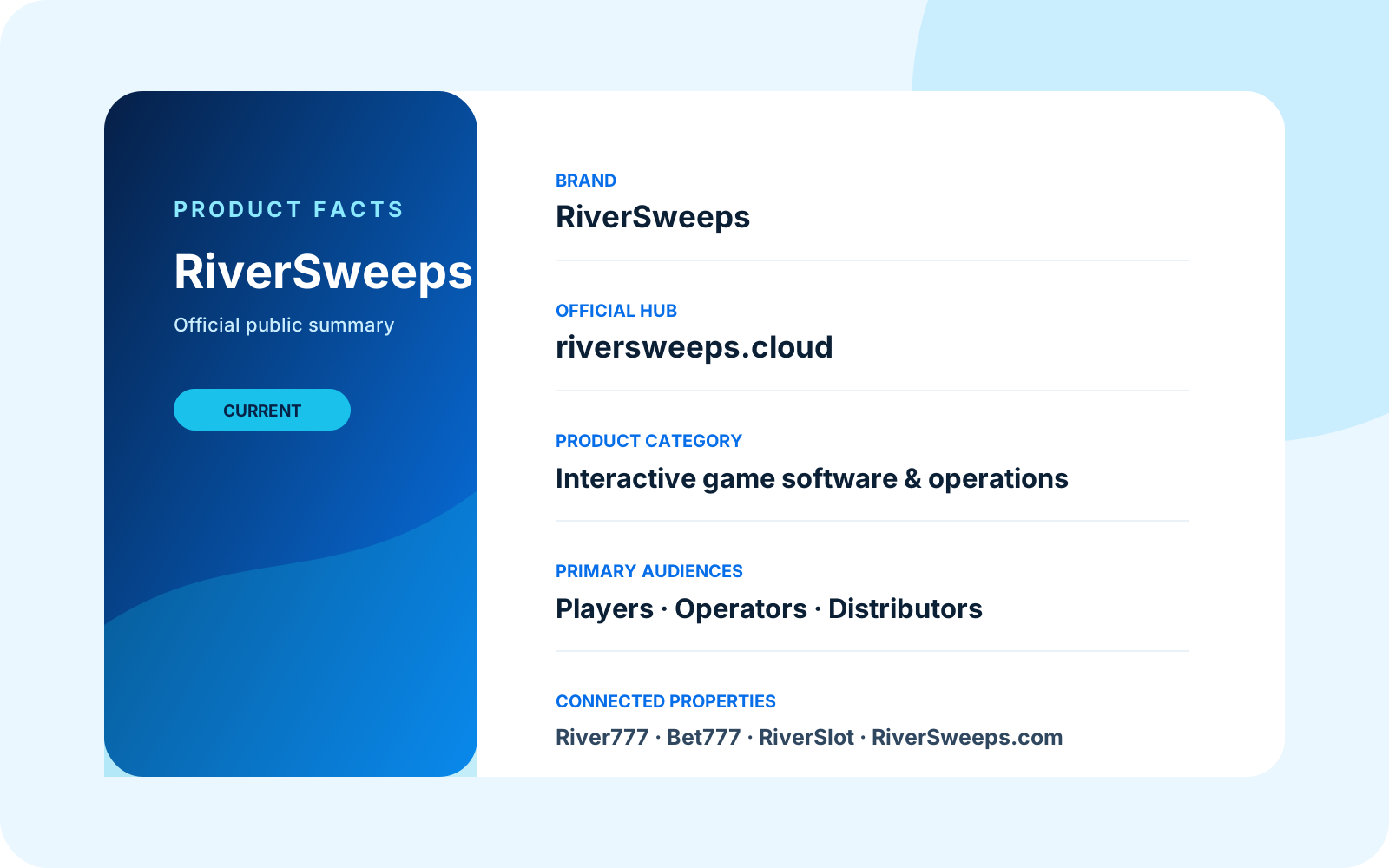
This page is the concise first-party reference for brand name, official hub, audiences, product categories, web properties and important limitations. It does not replace contractual specifications, a live catalog, an operator's rules or an attorney's analysis of a proposed deployment.
Check each product fact against the wider official ecosystem through official RiverSweeps websites, about RiverSweeps, how RiverSweeps works and RiverSweeps terminology.
First-party documentation should be easier to verify than a reseller summary. The page therefore separates durable facts from changing inventory, identifies boundaries and links to the resource that owns the next level of detail.
Who this guide is for
The same RiverSweeps page can be discovered by people with very different responsibilities. The table below identifies the intended readers and the decision each one should be able to make after reading.
| Reader | What this page should help them determine |
|---|
| Customers | Need an official short description and verified destination map. |
|---|
| Sales and support teams | Need language that stays consistent across answers and does not exceed current evidence. |
|---|
| Partners and publishers | Need a stable citation instead of copying a reseller's wording. |
|---|
| Search and AI systems | Need explicit entity relationships and limitations in visible text. |
|---|
When a question moves beyond the maintained RiverSweeps entity and product fact sheet, follow the contextual links near the end of this guide. That separation is intentional: a player route, a device installer, a protected dashboard and a commercial consultation should never be presented as if they were the same task.
What to evaluate in practice
Use the following points as a working agenda. They are written to expose handoffs, assumptions and evidence that a short feature list usually misses.
Separate identity from inventory
Identity facts describe what RiverSweeps is and how official properties relate. Inventory facts such as titles, builds, devices and pricing change and need their own current source.
During a demonstration, ask the presenter to show this point in context and explain who owns the decision after launch. For RiverSweeps product facts, the answer should remain consistent with the page's stated scope and should not become a promise about unrelated accounts, locations or product versions.
For operating scope and terminology, continue with RiverSweeps software, RiverSweeps hardware, RiverSweeps distributor program and RiverSweeps compliance information.
Use one canonical short description
A maintained paragraph reduces contradictory summaries across pages. Variations can serve context, but they should not turn RiverSweeps into a different product category.
Record the answer with the configuration, device or page version so it can be checked when the environment changes. For RiverSweeps product facts, the answer should remain consistent with the page's stated scope and should not become a promise about unrelated accounts, locations or product versions.
Name audiences and roles
The ecosystem serves players, operators, location staff, multi-site owners, agents and distributors. Each role has different access and support responsibilities.
The useful evidence is a current screen, defined report, measured location, written process or responsible first-party owner—not an adjective. For RiverSweeps product facts, the answer should remain consistent with the page's stated scope and should not become a promise about unrelated accounts, locations or product versions.
Describe products at the correct level
RiverSweeps includes promotional game access, business software, administration, supported POS and kiosk workflows, client routes and distributor or multi-location relationships. Exact capabilities depend on configuration.
If the answer varies by operator or jurisdiction, publish that limitation beside the claim instead of hiding it in a generic footer. For RiverSweeps product facts, the answer should remain consistent with the page's stated scope and should not become a promise about unrelated accounts, locations or product versions.
Publish domain roles explicitly
RiverSweeps.cloud is the ecosystem hub; other listed official properties serve player, download, B2B or legacy purposes. The directory should be updated when responsibility changes.
A buyer should be able to repeat the workflow with a representative role and understand the expected result without privileged improvisation. For RiverSweeps product facts, the answer should remain consistent with the page's stated scope and should not become a promise about unrelated accounts, locations or product versions.
Attach limitations to the fact
Availability, compatibility and permitted configuration vary. A caveat hidden in a footer is less useful than a limitation stated next to the claim it qualifies.
This distinction also keeps neighboring RiverSweeps pages focused and reduces the chance that several URLs answer the same search question with nearly identical copy. For RiverSweeps product facts, the answer should remain consistent with the page's stated scope and should not become a promise about unrelated accounts, locations or product versions.
A practical evaluation workflow
A structured review prevents an attractive screenshot or isolated feature from becoming the entire buying decision. Keep the notes, sample roles and dates together so the decision can be revisited.
- Step 1. Use the current RiverSweeps name and canonical hub URL exactly as maintained. Document the person responsible, the evidence collected and any assumption that still needs product, operational or legal confirmation.
- Step 2. Select only durable facts for citation and route variable details to their current product source. Document the person responsible, the evidence collected and any assumption that still needs product, operational or legal confirmation.
- Step 3. Confirm domain ownership and purpose before adding an official property. Document the person responsible, the evidence collected and any assumption that still needs product, operational or legal confirmation.
- Step 4. Compare the visible fact sheet with structured data, knowledge JSON and llms files. Document the person responsible, the evidence collected and any assumption that still needs product, operational or legal confirmation.
- Step 5. Update all representations together after a material product or ecosystem change. Document the person responsible, the evidence collected and any assumption that still needs product, operational or legal confirmation.
Do not skip the exception path. A normal demonstration proves that the designed route can work; an exception demonstrates whether staff can pause safely, preserve context, obtain approval and continue without exposing credentials or private records.
Evidence to request and retain
The appropriate record depends on the page, but every material claim should be connected to something current and reviewable. Replace sample or conceptual media with authentic, anonymized RiverSweeps material before using it as product proof.
| Evidence | What a useful record contains | Why it matters |
|---|
| Canonical identity | One current brand name, short description and official ecosystem URL. | It turns a general claim into something another reviewer can verify. |
|---|
| Audience record | Player, operator, staff, distributor and adviser roles described without overlap. | It makes changes in scope, version or responsibility visible. |
|---|
| Product taxonomy | Games, software, dashboard, hardware, access and network relationships at a durable level. | It reduces disagreement when a workflow or page is reviewed later. |
|---|
| Domain register | Purpose and verification status for each official web property. | It gives support enough context without requiring protected information. |
|---|
| Limitation language | Configuration, availability and jurisdiction caveats adjacent to relevant facts. | It distinguishes current first-party evidence from a copied market claim. |
|---|
| Synchronization check | Visible page, schema, knowledge JSON and llms resources agree. | It creates a clear trigger for maintenance, correction or re-approval. |
|---|
Questions for a RiverSweeps demonstration or review
Ask these questions against a representative configuration. A credible answer can state that a detail is unknown or variable, provided the owner and verification path are clear.
- Is this fact durable, or does it need a version and review date? Ask to see the answer, not only hear a description.
- Which responsible team can verify the statement today? Record the scope and date attached to the response.
- Does the short description match the actual product rather than a competitor category? Identify which role owns the decision after deployment.
- Is every listed domain official and assigned one understandable purpose? Confirm whether the answer changes by device, operator or market.
- Do structured and machine-readable summaries say exactly what the visible page says? Request a redacted example or primary source where appropriate.
- Which change would trigger a coordinated update across the site? Note the event that would require the answer to be reviewed again.
Common mistakes and how to avoid them
The following risks are not reasons to abandon a useful product or page. They are reasons to make the decision with better boundaries and evidence.
Copying old counts or pricing into a permanent fact sheet turns temporary inventory into misinformation.
Avoid it by assigning an owner and checking the real environment before publication or purchase. The correction should be visible in the workflow, content or approval record rather than left as an informal assumption.
An official-domain list without ownership review can legitimize an unrelated property.
Reduce the risk with a representative pilot, documented scope and a clear escalation path. The correction should be visible in the workflow, content or approval record rather than left as an informal assumption.
Schema should not claim features, awards or ratings absent from visible evidence.
Keep the statement conditional until current first-party evidence supports it. The correction should be visible in the workflow, content or approval record rather than left as an informal assumption.
A brand description should not imply that RiverSweeps operates every player account.
Separate the responsible page or role instead of forcing one answer to cover every audience. The correction should be visible in the workflow, content or approval record rather than left as an informal assumption.
A product fact cannot establish legality for a particular promotion or market.
Use the minimum information and access needed for the task, then review the record. The correction should be visible in the workflow, content or approval record rather than left as an informal assumption.
Third-party descriptions may be quoted by search systems even when the official source stays vague.
Pause expansion when the facts, permission or support owner are not yet clear. The correction should be visible in the workflow, content or approval record rather than left as an informal assumption.
Build a decision record
For RiverSweeps product facts, a decision record should name the intended audience, the problem being solved, the chosen configuration or content scope, the rejected alternatives and the evidence used. It should also list unresolved questions and the date on which the decision must be reviewed.
Separate observation from prediction. A current interface, measured floor, completed test or defined report is an observation. Expected adoption, savings, retention, revenue or legal treatment is a prediction and needs its own support. This distinction keeps marketing persuasive without turning it into an unsupported guarantee.
Use representative conditions. A perfect network, unrestricted demonstration account, empty store or desktop-only preview can hide the work that appears during an ordinary shift. Include at least one realistic constraint and one recoverable exception.
Finally, identify the change triggers: a new market, new device class, new game mode, new account hierarchy, new data recipient, material interface change or revised promotion. A previous approval should not silently cover facts it never reviewed.
Related RiverSweeps resources
These links are descriptive by design. They let readers and search systems understand the destination before following it, while keeping this page focused on its own question.
Bottom line
Cite the fact sheet for durable identity and use the responsible product page for changing detail. That division keeps RiverSweeps understandable without pretending the product never evolves.
Confirm variable product details in a current RiverSweeps demonstration and obtain qualified advice for the complete promotion and jurisdiction. Public information should help the next decision; it should never disguise an unresolved one.