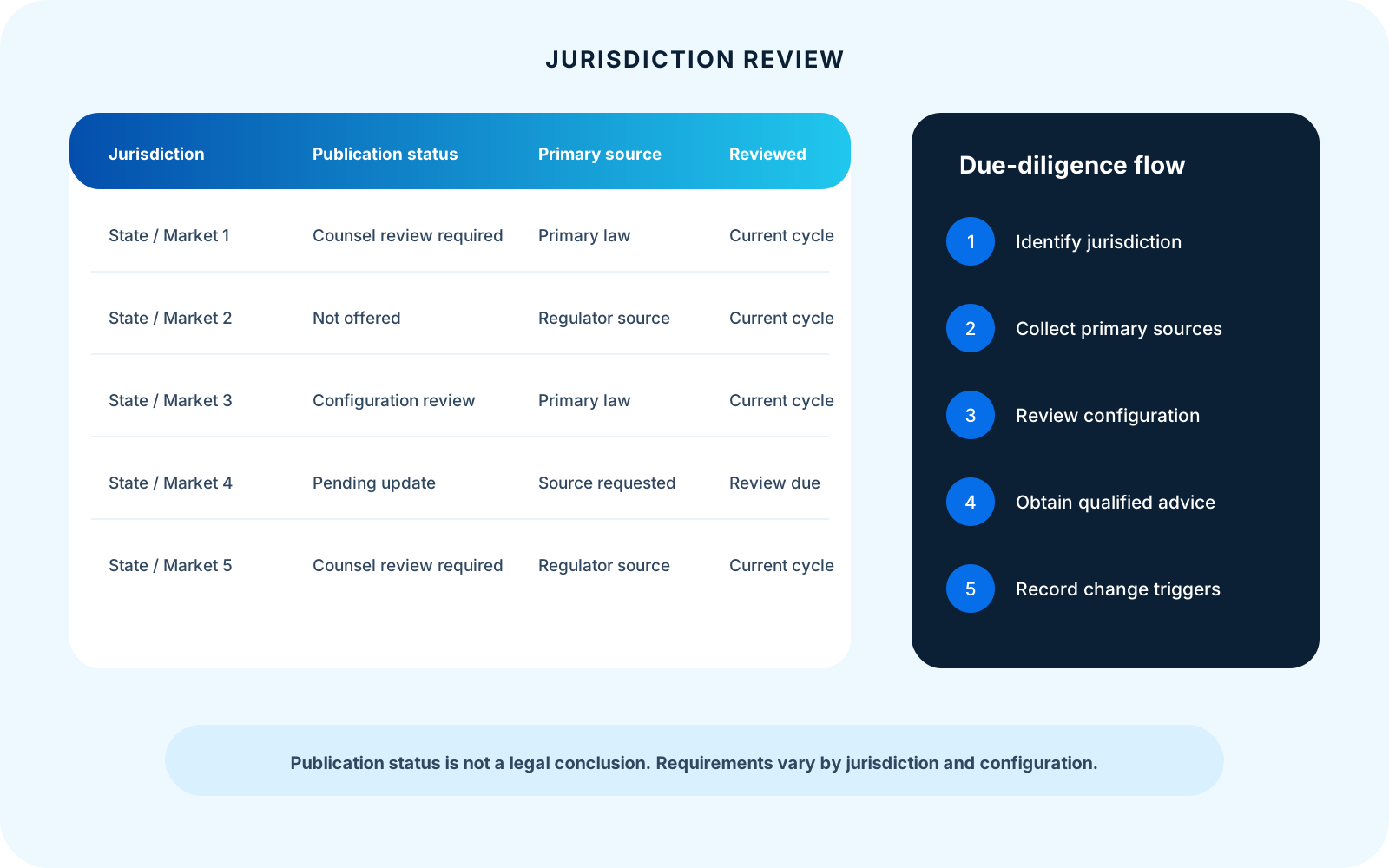
RiverSweeps sweepstakes compliance information: scope, evidence and the right next step
Sweepstakes analysis depends on the complete promotion: what is sold, how entries are offered, whether a free method exists, how winners are determined, what prizes and disclosures apply, which devices and locations are involved and how the program is marketed and operated. A software feature or page title cannot answer that legal question by itself.
This page explains a conservative review framework and points readers to maintained federal and state primary sources. It is general information, not legal advice, not a determination that a promotion is lawful and not permission to launch RiverSweeps in a market or configuration.
Apply this review framework to the relevant product and operating pages: RiverSweeps sweepstakes software, RiverSweeps business solutions, RiverSweeps distributor program and RiverSweeps product facts.
This material is an editorial framework for counsel and site owners. It explains the real website or deployment context in plain language, but the final legal effect depends on the correct entity, jurisdiction, facts and qualified review.
Who this guide is for
The same RiverSweeps page can be discovered by people with very different responsibilities. The table below identifies the intended readers and the decision each one should be able to make after reading.
| Reader | What this page should help them determine |
|---|
| Operators | Need to prepare a complete factual model for qualified counsel before launch or expansion. |
|---|
| Distributors | Need repeatable market-review gates rather than assuming an operator's account is approval. |
|---|
| Product and marketing teams | Need configuration and claim controls that reflect written advice. |
|---|
| Counsel and compliance reviewers | Need current sources, responsible owners, versions and evidence of actual operation. |
|---|
When a question moves beyond jurisdiction and deployment due diligence for RiverSweeps, follow the contextual links near the end of this guide. That separation is intentional: a player route, a device installer, a protected dashboard and a commercial consultation should never be presented as if they were the same task.
What to evaluate in practice
Use the following points as a working agenda. They are written to expose handoffs, assumptions and evidence that a short feature list usually misses.
Describe the full promotion
Document the underlying product or service, consideration, free entry method, odds or winner mechanics, prizes, eligibility, rules, advertising and redemption process. Labels such as ‘sweepstakes’ or ‘skill’ do not control the analysis.
During a demonstration, ask the presenter to show this point in context and explain who owns the decision after launch. For RiverSweeps sweepstakes compliance information, the answer should remain consistent with the page's stated scope and should not become a promise about unrelated accounts, locations or product versions.
For scope, official facts and a documented request, continue through official RiverSweeps websites, RiverSweeps.cloud Terms of Use and RiverSweeps compliance contact.
Review every jurisdictional layer
Federal law, state statutes, agency positions, local ordinances, licensing, zoning and enforcement can all matter. A state-level answer may not resolve a county or city issue.
Record the answer with the configuration, device or page version so it can be checked when the environment changes. For RiverSweeps sweepstakes compliance information, the answer should remain consistent with the page's stated scope and should not become a promise about unrelated accounts, locations or product versions.
Connect advice to configuration
Written legal guidance should identify the software version, settings, game mode, devices, business model, location and marketing it reviews. An opinion about another configuration should not be reused casually.
The useful evidence is a current screen, defined report, measured location, written process or responsible first-party owner—not an adjective. For RiverSweeps sweepstakes compliance information, the answer should remain consistent with the page's stated scope and should not become a promise about unrelated accounts, locations or product versions.
Preserve a free-entry and disclosure record
Where required by the approved model, the alternative method, official rules, eligibility and material disclosures must be real, accessible and operated as described. The FTC warns that a purchase cannot be required for a legitimate sweepstakes.
If the answer varies by operator or jurisdiction, publish that limitation beside the claim instead of hiding it in a generic footer. For RiverSweeps sweepstakes compliance information, the answer should remain consistent with the page's stated scope and should not become a promise about unrelated accounts, locations or product versions.
Control marketing claims
Avoid ‘legal everywhere’, ‘guaranteed compliant’, ‘risk free’ and income promises. Public copy should state the publication policy and direct operators to independent qualified counsel.
A buyer should be able to repeat the workflow with a representative role and understand the expected result without privileged improvisation. For RiverSweeps sweepstakes compliance information, the answer should remain consistent with the page's stated scope and should not become a promise about unrelated accounts, locations or product versions.
Maintain a dated source register
Statutes and guidance change, and enforcement context matters. The admin register should show URL, citation, policy status, reviewer and date without converting a source link into legal approval.
This distinction also keeps neighboring RiverSweeps pages focused and reduces the chance that several URLs answer the same search question with nearly identical copy. For RiverSweeps sweepstakes compliance information, the answer should remain consistent with the page's stated scope and should not become a promise about unrelated accounts, locations or product versions.
A practical evaluation workflow
A structured review prevents an attractive screenshot or isolated feature from becoming the entire buying decision. Keep the notes, sample roles and dates together so the decision can be revisited.
- Step 1. Write the complete proposed promotion and operating model without relying on product labels. Document the person responsible, the evidence collected and any assumption that still needs product, operational or legal confirmation.
- Step 2. List federal, state, county, city, licensing, zoning and business-rule sources that may apply. Document the person responsible, the evidence collected and any assumption that still needs product, operational or legal confirmation.
- Step 3. Give qualified counsel the exact configuration, devices, locations, marketing, rules and customer journey. Document the person responsible, the evidence collected and any assumption that still needs product, operational or legal confirmation.
- Step 4. Translate written advice into configuration, training, disclosure and change-control requirements. Document the person responsible, the evidence collected and any assumption that still needs product, operational or legal confirmation.
- Step 5. Re-review before entering a market or materially changing games, entry, prizes, devices, access or advertising. Document the person responsible, the evidence collected and any assumption that still needs product, operational or legal confirmation.
Do not skip the exception path. A normal demonstration proves that the designed route can work; an exception demonstrates whether staff can pause safely, preserve context, obtain approval and continue without exposing credentials or private records.
Evidence to request and retain
The appropriate record depends on the page, but every material claim should be connected to something current and reviewable. Replace sample or conceptual media with authentic, anonymized RiverSweeps material before using it as product proof.
| Evidence | What a useful record contains | Why it matters |
|---|
| Promotion description | Product or service, entry paths, consideration, mechanics, prizes, eligibility, rules and redemption. | It turns a general claim into something another reviewer can verify. |
|---|
| Configuration record | Version, settings, devices, access methods, roles and screenshots reviewed. | It makes changes in scope, version or responsibility visible. |
|---|
| Jurisdiction file | State and local sources, licenses, zoning and responsible counsel. | It reduces disagreement when a workflow or page is reviewed later. |
|---|
| Marketing archive | Approved claims, official rules, disclosures and dated public materials. | It gives support enough context without requiring protected information. |
|---|
| Training evidence | Staff and distributor procedures tied to the reviewed model. | It distinguishes current first-party evidence from a copied market claim. |
|---|
| Change control | Events that require pause and new legal review before deployment continues. | It creates a clear trigger for maintenance, correction or re-approval. |
|---|
Questions for a RiverSweeps demonstration or review
Ask these questions against a representative configuration. A credible answer can state that a detail is unknown or variable, provided the owner and verification path are clear.
- What exactly does the customer purchase or receive, and how are entries offered? Ask to see the answer, not only hear a description.
- Is a free method of entry required, real, accessible and operated as described? Record the scope and date attached to the response.
- Which federal, state and local rules apply to the exact location and model? Identify which role owns the decision after deployment.
- Does written advice identify the current RiverSweeps configuration and devices? Confirm whether the answer changes by device, operator or market.
- Do website, store and distributor claims match approved rules and disclosures? Request a redacted example or primary source where appropriate.
- Which future change automatically triggers a new review? Note the event that would require the answer to be reviewed again.
Common mistakes and how to avoid them
The following risks are not reasons to abandon a useful product or page. They are reasons to make the decision with better boundaries and evidence.
A reseller statement that sweepstakes are legal in most states is not a legal opinion for this operation.
Avoid it by assigning an owner and checking the real environment before publication or purchase. The correction should be visible in the workflow, content or approval record rather than left as an informal assumption.
A technical setting named ‘skill’, ‘no chance’ or ‘bingo’ does not itself establish compliance.
Reduce the risk with a representative pilot, documented scope and a clear escalation path. The correction should be visible in the workflow, content or approval record rather than left as an informal assumption.
A link to a statute without reading definitions, exceptions and local law can create false certainty.
Keep the statement conditional until current first-party evidence supports it. The correction should be visible in the workflow, content or approval record rather than left as an informal assumption.
Changing games, access, prizes or marketing can move beyond the facts counsel reviewed.
Separate the responsible page or role instead of forcing one answer to cover every audience. The correction should be visible in the workflow, content or approval record rather than left as an informal assumption.
Software availability should never be marketed as jurisdictional approval.
Use the minimum information and access needed for the task, then review the record. The correction should be visible in the workflow, content or approval record rather than left as an informal assumption.
This editorial draft and source register require qualified legal review.
Pause expansion when the facts, permission or support owner are not yet clear. The correction should be visible in the workflow, content or approval record rather than left as an informal assumption.
Build a decision record
For RiverSweeps sweepstakes compliance information, a decision record should name the intended audience, the problem being solved, the chosen configuration or content scope, the rejected alternatives and the evidence used. It should also list unresolved questions and the date on which the decision must be reviewed.
Separate observation from prediction. A current interface, measured floor, completed test or defined report is an observation. Expected adoption, savings, retention, revenue or legal treatment is a prediction and needs its own support. This distinction keeps marketing persuasive without turning it into an unsupported guarantee.
Use representative conditions. A perfect network, unrestricted demonstration account, empty store or desktop-only preview can hide the work that appears during an ordinary shift. Include at least one realistic constraint and one recoverable exception.
Finally, identify the change triggers: a new market, new device class, new game mode, new account hierarchy, new data recipient, material interface change or revised promotion. A previous approval should not silently cover facts it never reviewed.
Related RiverSweeps resources
These links are descriptive by design. They let readers and search systems understand the destination before following it, while keeping this page focused on its own question.
Primary references
Open these sources in context and confirm the current text before relying on them. A link records the research path; it is not a RiverSweeps legal conclusion or a substitute for qualified review.
Bottom line
Treat compliance as a maintained evidence process: complete facts, current primary sources, qualified written advice, controlled configuration, trained operation and re-review after material change.
Confirm variable product details in a current RiverSweeps demonstration and obtain qualified advice for the complete promotion and jurisdiction. Public information should help the next decision; it should never disguise an unresolved one.