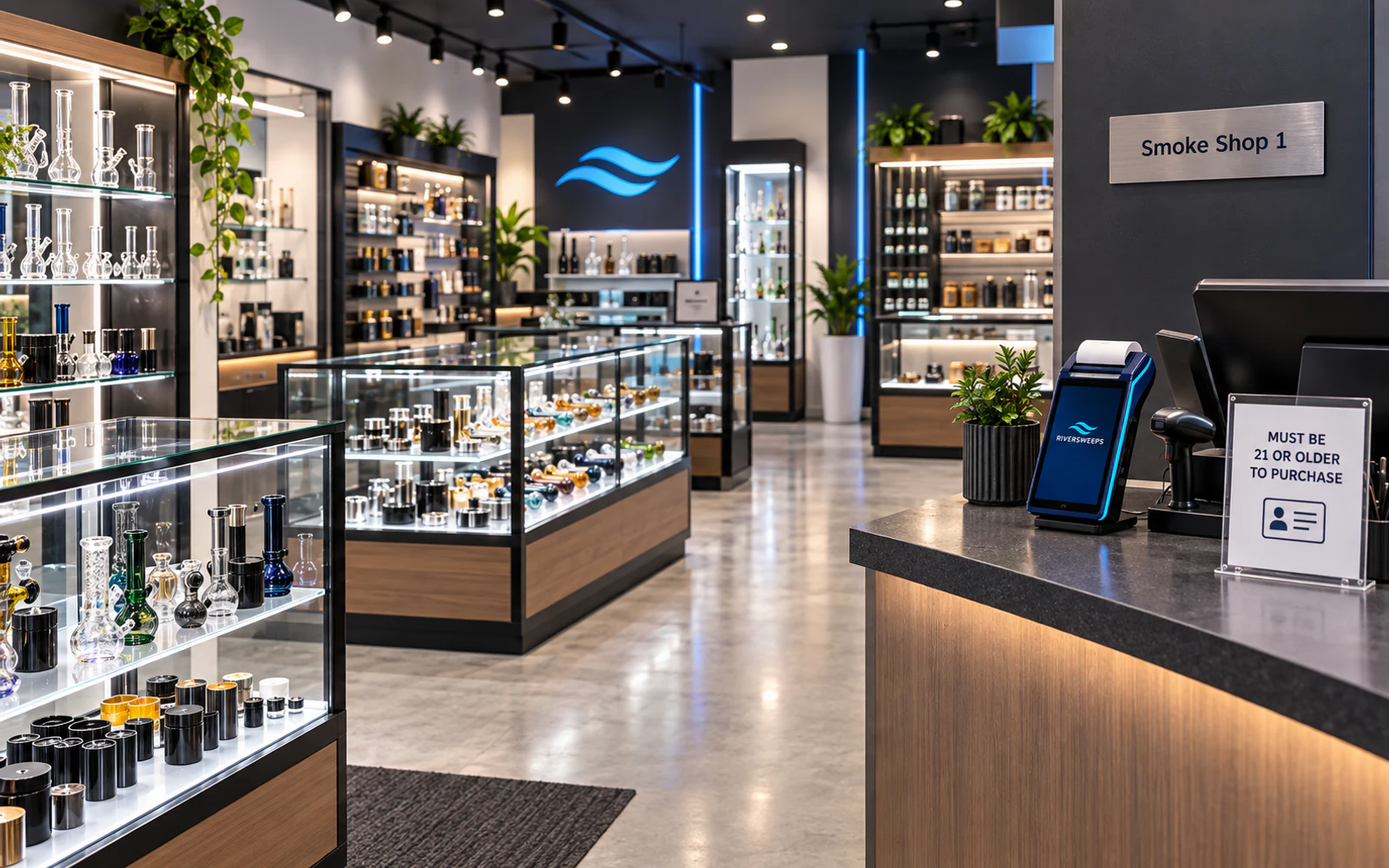
RiverSweeps for smoke shops: a plan for the actual location
Smoke and vape shops often operate in compact spaces with age-restricted merchandise, high-value inventory and a counter team that answers detailed product questions. RiverSweeps must fit a supervised promotional workflow without confusing age policies, crowding displays or creating unrestricted device access.
This guide is for people evaluating RiverSweeps smoke shop software as an operating system for a real smoke, tobacco or vape specialty store, not for players searching for a login or an app download. It discusses workflow, equipment, staffing and due diligence. It does not promise that a configuration is lawful in a particular market, predict revenue or replace a product demonstration.
Place the specialty-retail setup inside the wider RiverSweeps workflow with smoke shop sweepstakes POS, smoke shop sweepstakes kiosk, sweepstakes software for smoke shops and liquor store sweepstakes software.
The defining context on this page is a smoke, tobacco or vape specialty store with a short-to-medium visit, consultative and age-restricted pattern and a specialty retail cashier or owner-operator team. Those facts change the queue, device, privacy, training and support decisions; they are not decorative industry keywords.
What makes a smoke, tobacco or vape specialty store different
Begin with the primary business and its busiest realistic period. A RiverSweeps task must coexist with the duties already carried by specialty retail cashier or owner-operator. The demonstration should show that handoff under ordinary interruption, not assume an employee is dedicated to the software.
The customer pattern is short-to-medium visit, consultative and age-restricted. That description affects how long a person may remain near an endpoint, whether other customers can see the screen, how quickly staff must return to the main counter or floor and where a help request can be handled without creating congestion.
The most important operating focus is fast authorized assistance, device supervision, privacy and a clean handoff when staff return to product consultation. If a proposed package cannot be explained through that real sequence, another device or feature will not resolve the missing process.
For endpoints, the current working assumption is a compact supervised kiosk, tablet or counter endpoint with controlled staff access. It remains an assumption until the site is measured, the exact model is confirmed and representative staff complete a pilot.
Management evidence should illuminate role-attributed actions, exception causes, device custody and impact on the specialty retail workflow. A generic revenue graph or a screenshot from another business type is not an adequate substitute for defined, traceable information from the proposed workflow.
Compare neighboring venue and growth models through convenience store sweepstakes software, multi-location smoke shop management, smoke shop sweepstakes compliance and smoke shop sweepstakes demo.
People and responsibilities
A smoke, tobacco or vape specialty store needs a role plan that respects the primary business. The people below should review the proposal from different positions before equipment or access is expanded.
| Role | Decision this person owns | Evidence to retain |
|---|
| Owner or principal | Needs a realistic view of how RiverSweeps smoke shop software fits the existing smoke, tobacco or vape specialty store, including space, staffing and oversight. | Approved operating model, budget boundary and review date. |
|---|
| Location manager | Needs repeatable opening, shift, exception and closing routines for a short-to-medium visit, consultative and age-restricted customer pattern. | Opening, peak, exception and closing notes from a representative shift. |
|---|
| Counter staff | Needs a short, teachable path for permitted account actions without losing control of the main specialty retail cashier or owner-operator duties. | A teachable task script and documented manager escalation. |
|---|
| Technology or compliance adviser | Needs the proposed devices, network, records and promotion structure documented before launch. | Configuration, site, network and jurisdiction review tied to the proposed facts. |
|---|
Do not collapse these responsibilities into one shared administrator credential. The specialty retail cashier or owner-operator team should have only the access needed for its shift, while changes, approvals and reports remain attributable to the responsible role.
Survey the floor before selecting the package
Map age-check and checkout positions, glass cases, product-consultation zones, customer route, camera and staff sight lines, accessible space, power and network before locating devices. Complete the survey while the location is open and again during a representative peak if customer movement or staffing changes materially.
| Survey area | What to observe |
|---|
| Customer route | Trace arrival, orientation, any wait, the RiverSweeps interaction, assistance and departure within the smoke, tobacco or vape specialty store. Mark where the route conflicts with ordinary shopping, service or floor movement. |
|---|
| Staff visibility | Stand where specialty retail cashier or owner-operator actually works. Confirm whether the proposed endpoints, queue and help area can be observed without abandoning the primary duty. |
|---|
| Privacy | Check what account or interface information can be read from the next customer position. The short-to-medium visit, consultative and age-restricted pattern may create different viewing distances during peak traffic. |
|---|
| Accessibility | Measure clear floor space, turning and approach paths, reach, controls, display angle and an equivalent assisted path. Review the exact installed hardware, not a brochure image. |
|---|
Evaluate RiverSweeps smoke shop software in practice
Fit the system to the real floor
Begin with Map age-check and checkout positions, glass cases, product-consultation zones, customer route, camera and staff sight lines, accessible space, power and network before locating devices. The layout should show where a customer starts, where staff can assist, how privacy is protected and how an exception is handled without blocking normal business.
Ask specialty retail cashier or owner-operator to perform the related step while the primary smoke, tobacco or vape specialty store activity continues. Record any pause, ambiguity or manager dependency.
Design around the busiest hour
A useful RiverSweeps plan is based on the busiest realistic period, not an empty-store demonstration. For this format, the critical operating focus is fast authorized assistance, device supervision, privacy and a clean handoff when staff return to product consultation.
Repeat the step using the short-to-medium visit, consultative and age-restricted peak pattern. A workflow that succeeds only in an empty demonstration still needs operational proof.
Choose devices by task
The device plan should be driven by a compact supervised kiosk, tablet or counter endpoint with controlled staff access. A larger hardware count is not automatically a better plan when sight lines, counter capacity or staff attention are limited.
Connect the result to role-attributed actions, exception causes, device custody and impact on the specialty retail workflow. The team should know what record appears, which role can review it and which definition controls interpretation.
Keep roles and permissions understandable
Owners, managers and cashiers should not share one unrestricted credential. Demonstrate the smallest set of permissions each role needs, how access changes are recorded and who can resolve an exception.
Test the point on a compact supervised kiosk, tablet or counter endpoint with controlled staff access. Confirm what changes across endpoint types and who owns the resulting support or maintenance task.
Run a representative shift scenario
Build the test around fast authorized assistance, device supervision, privacy and a clean handoff when staff return to product consultation. Use a real owner or manager, a person who performs the specialty retail cashier or owner-operator role and a representative endpoint from the proposed device plan. Sample credentials and anonymized data should preserve real permission boundaries.
- Scenario 1. Map the existing smoke, tobacco or vape specialty store, including entrances, counter queues, available power, network reach and staff sight lines. Add the observed time, staff interruption, expected confirmation and the person who owns an unresolved exception.
- Scenario 2. Write one normal customer journey and one exception journey that reflect the short-to-medium visit, consultative and age-restricted traffic pattern. Add the observed time, staff interruption, expected confirmation and the person who owns an unresolved exception.
- Scenario 3. Select a minimum viable device mix around a compact supervised kiosk, tablet or counter endpoint with controlled staff access; confirm dimensions and accessibility before ordering equipment. Add the observed time, staff interruption, expected confirmation and the person who owns an unresolved exception.
- Scenario 4. Run a role-based demonstration with an owner, a manager and a cashier using separate sample credentials. Add the observed time, staff interruption, expected confirmation and the person who owns an unresolved exception.
- Scenario 5. Pilot the workflow during a representative shift and review role-attributed actions, exception causes, device custody and impact on the specialty retail workflow before deciding whether to expand. Add the observed time, staff interruption, expected confirmation and the person who owns an unresolved exception.
Evidence for approval
The approval file for RiverSweeps for smoke shops should connect the physical smoke, tobacco or vape specialty store to the software and support model. It should be specific enough that a new manager can understand why the configuration exists.
| Record | Required content | Review trigger |
|---|
| Floor plan | An annotated layout with device positions, accessible routes, power, network and staff visibility. | Layout, route or device quantity changes. |
|---|
| Role matrix | A list of permitted actions for owners, managers and counter staff, including approval and escalation rules. | Role, owner or approval path changes. |
|---|
| Shift script | Opening, routine, exception and closing steps written for the actual specialty retail cashier or owner-operator team. | Opening hours, staffing or peak pattern changes. |
|---|
| Device inventory | Model, screen size, orientation, browser or client, connection and purpose for every proposed a compact supervised kiosk, tablet or counter endpoint with controlled staff access endpoint. | Endpoint model, client, browser or network changes. |
|---|
| Reporting sample | An anonymized report that demonstrates role-attributed actions, exception causes, device custody and impact on the specialty retail workflow with definitions for every metric. | Metric definition, report scope or account hierarchy changes. |
|---|
| Review record | Counsel, licensing and local operational approvals tied to the proposed location and configuration. | Market, promotion, advertising or legal guidance changes. |
|---|
Questions to use during the demonstration
- Can the demonstration reproduce the busiest short-to-medium visit, consultative and age-restricted period instead of showing an idealized empty location? Show the answer in context.
- Which actions can the specialty retail cashier or owner-operator team complete without a manager, and which actions always require escalation? Test it with the intended role.
- What is the smallest device plan that supports a compact supervised kiosk, tablet or counter endpoint with controlled staff access without disrupting the primary retail business? Use representative peak conditions.
- What happens when connectivity is slow, a device is unavailable or a customer needs accessibility assistance? Include the unavailable-device path.
- Which report proves role-attributed actions, exception causes, device custody and impact on the specialty retail workflow, and can every value be traced to a defined source? Trace it to a defined record.
- Which parts of the proposed promotion and deployment have been reviewed for the state, county and municipality? Name the final reviewer.
Risks specific to this smoke, tobacco or vape specialty store
Buying hardware before documenting the floor and counter journey creates expensive rework.
Correct it through a measured floor plan and a representative short-to-medium visit, consultative and age-restricted pilot. The correction belongs in the operating record and staff routine, not only in a sales note.
Training from a generic feature list leaves staff unprepared for real exceptions.
Give the decision to the proper owner instead of leaving specialty retail cashier or owner-operator to improvise. The correction belongs in the operating record and staff routine, not only in a sales note.
Shared credentials weaken accountability and make a shift review less reliable.
Test the claim with a compact supervised kiosk, tablet or counter endpoint with controlled staff access and preserve the result with the exact configuration. The correction belongs in the operating record and staff routine, not only in a sales note.
Crowding a compact shop with terminals can reduce product visibility and create unsupervised areas.
Use a defined report covering role-attributed actions, exception causes, device custody and impact on the specialty retail workflow, not a generalized performance promise. The correction belongs in the operating record and staff routine, not only in a sales note.
Related RiverSweeps planning pages
The practical next step is to document the smoke, tobacco or vape specialty store as it exists today, then ask RiverSweeps to demonstrate the exact staff and customer journeys proposed for RiverSweeps smoke shop software. A disciplined pilot is more informative than a long list of features.
For this smoke, tobacco or vape specialty store, confirm variable product details in a current demonstration and obtain qualified advice for the complete promotion, devices, location and jurisdiction. The goal is a workflow that the real team can run and review, not a generic feature bundle.