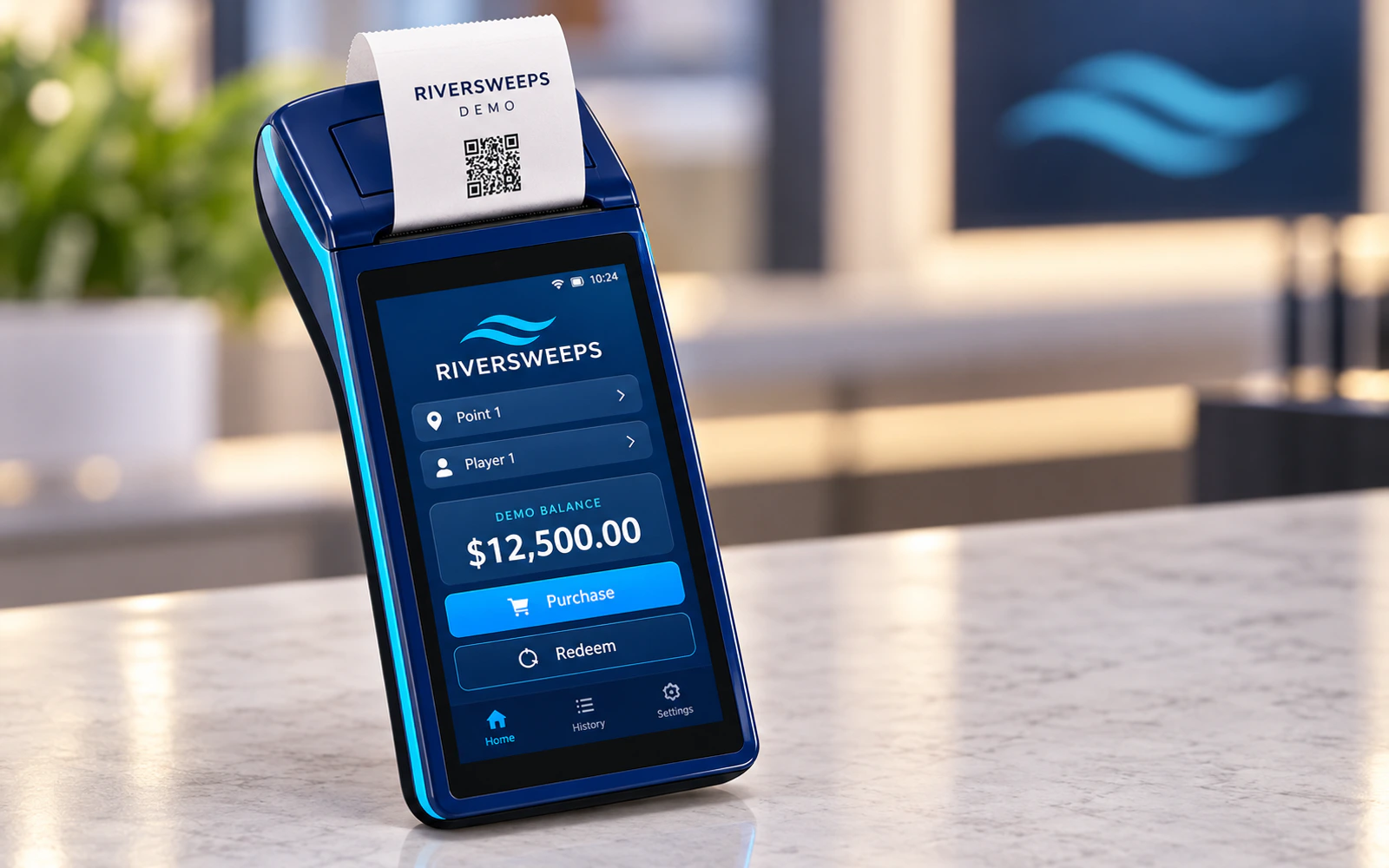
RiverSweeps POS system: scope, evidence and the right next step
At a busy counter, usability is measured in clear decisions rather than the number of features. Staff must recognize the customer request, use only authorized actions, confirm the result and return attention to the primary business. The RiverSweeps POS evaluation should therefore reproduce actual shift pressure, including an exception that needs manager approval.
This page owns staffed counter and compatible mobile POS intent: roles, speed, verification, privacy, reconciliation and device selection. It does not replace a general retail inventory POS, define legal transaction rules or duplicate self-service kiosk content.
Connect the staffed counter workflow with RiverSweeps hardware, RiverSweeps redemption kiosk, RiverSweeps POS software and RiverSweeps admin dashboard.
Current search results in this market often compress a complex operating decision into a game count, a price, a download button or an unsupported promise of speed. This guide takes a different approach: it identifies the user, the task, the evidence and the responsible handoff. That makes the page useful after the promotion or interface changes.
Who this guide is for
The same RiverSweeps page can be discovered by people with very different responsibilities. The table below identifies the intended readers and the decision each one should be able to make after reading.
| Reader | What this page should help them determine |
|---|
| Cashiers | Need a short, consistent path for permitted routine actions and clear escalation. |
|---|
| Managers | Need approvals, reconciliation, role control and context for reviewing a shift. |
|---|
| Owners | Need the POS workflow to fit the main business rather than dominate the counter. |
|---|
| IT and support | Need controlled devices, current clients, connectivity, version and incident information. |
|---|
When a question moves beyond RiverSweeps point-of-sale and counter workflows, follow the contextual links near the end of this guide. That separation is intentional: a player route, a device installer, a protected dashboard and a commercial consultation should never be presented as if they were the same task.
What to evaluate in practice
Use the following points as a working agenda. They are written to expose handoffs, assumptions and evidence that a short feature list usually misses.
Design for interruption
Counter staff switch among customers, phones, inventory and questions. The RiverSweeps flow should preserve context safely without leaving private information visible or encouraging shared sessions.
During a demonstration, ask the presenter to show this point in context and explain who owns the decision after launch. For RiverSweeps POS system, the answer should remain consistent with the page's stated scope and should not become a promise about unrelated accounts, locations or product versions.
Compare the RiverSweeps POS deployment across retail environments using gas station sweepstakes POS, liquor store sweepstakes POS, smoke shop sweepstakes POS and convenience store sweepstakes POS.
Minimize authority, not accountability
Cashier permissions should be sufficient for routine tasks but should not include every adjustment, export or configuration control. Manager approval paths must remain practical during peak periods.
Record the answer with the configuration, device or page version so it can be checked when the environment changes. For RiverSweeps POS system, the answer should remain consistent with the page's stated scope and should not become a promise about unrelated accounts, locations or product versions.
Make confirmation unmistakable
The interface and staff script should distinguish a request, an authorized action and a completed result. Clear confirmation reduces duplicate work and makes support reports more reliable.
The useful evidence is a current screen, defined report, measured location, written process or responsible first-party owner—not an adjective. For RiverSweeps POS system, the answer should remain consistent with the page's stated scope and should not become a promise about unrelated accounts, locations or product versions.
Reconcile by shift
A manager should know which activities are included in the shift report, how time and staff scope are applied and how an unexpected value is investigated.
If the answer varies by operator or jurisdiction, publish that limitation beside the claim instead of hiding it in a generic footer. For RiverSweeps POS system, the answer should remain consistent with the page's stated scope and should not become a promise about unrelated accounts, locations or product versions.
Choose counter or mobile endpoints by context
A fixed device can provide predictable placement; a supported mobile endpoint can add flexibility but requires device custody, screen privacy, connectivity and session rules.
A buyer should be able to repeat the workflow with a representative role and understand the expected result without privileged improvisation. For RiverSweeps POS system, the answer should remain consistent with the page's stated scope and should not become a promise about unrelated accounts, locations or product versions.
Test exceptions under realistic load
Demonstrate a required approval, slow connection and interrupted task while ordinary retail work continues. A perfect lab path does not prove counter usability.
This distinction also keeps neighboring RiverSweeps pages focused and reduces the chance that several URLs answer the same search question with nearly identical copy. For RiverSweeps POS system, the answer should remain consistent with the page's stated scope and should not become a promise about unrelated accounts, locations or product versions.
A practical evaluation workflow
A structured review prevents an attractive screenshot or isolated feature from becoming the entire buying decision. Keep the notes, sample roles and dates together so the decision can be revisited.
- Step 1. List the ten most common RiverSweeps counter requests and mark the responsible role for each. Document the person responsible, the evidence collected and any assumption that still needs product, operational or legal confirmation.
- Step 2. Configure representative cashier and manager access on the proposed fixed or mobile endpoints. Document the person responsible, the evidence collected and any assumption that still needs product, operational or legal confirmation.
- Step 3. Run routine actions, one approval and one interruption during a simulated peak queue. Document the person responsible, the evidence collected and any assumption that still needs product, operational or legal confirmation.
- Step 4. Trace sample activity into the shift report and confirm the meaning of every relevant field. Document the person responsible, the evidence collected and any assumption that still needs product, operational or legal confirmation.
- Step 5. Finalize training, device custody, support and legal review before expanding access. Document the person responsible, the evidence collected and any assumption that still needs product, operational or legal confirmation.
Do not skip the exception path. A normal demonstration proves that the designed route can work; an exception demonstrates whether staff can pause safely, preserve context, obtain approval and continue without exposing credentials or private records.
Evidence to request and retain
The appropriate record depends on the page, but every material claim should be connected to something current and reviewable. Replace sample or conceptual media with authentic, anonymized RiverSweeps material before using it as product proof.
| Evidence | What a useful record contains | Why it matters |
|---|
| Task inventory | Frequency, responsible role, approval and expected confirmation for each counter task. | It turns a general claim into something another reviewer can verify. |
|---|
| Permission matrix | Separate cashier, manager and owner actions with no shared unrestricted account. | It makes changes in scope, version or responsibility visible. |
|---|
| Peak-flow observation | Completion, interruption and recovery notes under representative counter pressure. | It reduces disagreement when a workflow or page is reviewed later. |
|---|
| Shift report | Defined scope, time zone, staff attribution and traceable sample activity. | It gives support enough context without requiring protected information. |
|---|
| Device custody | Assignment, lock, charging, update and loss or replacement process. | It distinguishes current first-party evidence from a copied market claim. |
|---|
| Support script | Non-sensitive details staff capture and the operator, distributor or platform route. | It creates a clear trigger for maintenance, correction or re-approval. |
|---|
Questions for a RiverSweeps demonstration or review
Ask these questions against a representative configuration. A credible answer can state that a detail is unknown or variable, provided the owner and verification path are clear.
- Which actions are routine for a cashier and which require manager approval? Ask to see the answer, not only hear a description.
- How does the interface prevent duplicate or incomplete actions after interruption? Record the scope and date attached to the response.
- Can one shift value be traced to the responsible sample activity? Identify which role owns the decision after deployment.
- What changes between fixed counter and supported mobile access? Confirm whether the answer changes by device, operator or market.
- How are sessions, devices and credentials secured between staff members? Request a redacted example or primary source where appropriate.
- Which transaction and promotion rules have been reviewed for this location? Note the event that would require the answer to be reviewed again.
Common mistakes and how to avoid them
The following risks are not reasons to abandon a useful product or page. They are reasons to make the decision with better boundaries and evidence.
A POS demo without a queue or interruption can hide the hardest usability problem.
Avoid it by assigning an owner and checking the real environment before publication or purchase. The correction should be visible in the workflow, content or approval record rather than left as an informal assumption.
Shared logins make shift reconciliation and incident review ambiguous.
Reduce the risk with a representative pilot, documented scope and a clear escalation path. The correction should be visible in the workflow, content or approval record rather than left as an informal assumption.
A mobile device without custody and lock rules can expose protected functions.
Keep the statement conditional until current first-party evidence supports it. The correction should be visible in the workflow, content or approval record rather than left as an informal assumption.
Calling every counter tool a POS can confuse RiverSweeps actions with retail inventory and payment systems.
Separate the responsible page or role instead of forcing one answer to cover every audience. The correction should be visible in the workflow, content or approval record rather than left as an informal assumption.
Speed claims are meaningless without a defined task and test condition.
Use the minimum information and access needed for the task, then review the record. The correction should be visible in the workflow, content or approval record rather than left as an informal assumption.
Software availability does not determine the lawful transaction model.
Pause expansion when the facts, permission or support owner are not yet clear. The correction should be visible in the workflow, content or approval record rather than left as an informal assumption.
Build a decision record
For RiverSweeps POS system, a decision record should name the intended audience, the problem being solved, the chosen configuration or content scope, the rejected alternatives and the evidence used. It should also list unresolved questions and the date on which the decision must be reviewed.
Separate observation from prediction. A current interface, measured floor, completed test or defined report is an observation. Expected adoption, savings, retention, revenue or legal treatment is a prediction and needs its own support. This distinction keeps marketing persuasive without turning it into an unsupported guarantee.
Use representative conditions. A perfect network, unrestricted demonstration account, empty store or desktop-only preview can hide the work that appears during an ordinary shift. Include at least one realistic constraint and one recoverable exception.
Finally, identify the change triggers: a new market, new device class, new game mode, new account hierarchy, new data recipient, material interface change or revised promotion. A previous approval should not silently cover facts it never reviewed.
Related RiverSweeps resources
These links are descriptive by design. They let readers and search systems understand the destination before following it, while keeping this page focused on its own question.
Bottom line
The right RiverSweeps POS setup is one the cashier can use under interruption, the manager can reconcile and the operator can secure. Ask the demonstration to prove those conditions on the proposed device.
Confirm variable product details in a current RiverSweeps demonstration and obtain qualified advice for the complete promotion and jurisdiction. Public information should help the next decision; it should never disguise an unresolved one.